What Is Furniture as a Service (FaaS)?
Furniture as a Service - or FaaS - is a circular subscription model that gives businesses access to fully designed, professionally installed office furniture for a monthly fee. Rather than buying assets that depreciate and eventually go to landfill, you subscribe to a service that keeps furniture in continuous use. This guide explains what FaaS is, how it works, and whether it is right for your business.

Table of Contents

Furniture as a Service: the definition
Furniture as a Service (FaaS) is an office furniture model in which a business pays a recurring monthly fee to access fully furnished workspace, rather than purchasing furniture outright. The provider retains ownership of all items throughout the contract, handles design, delivery, and installation, and takes responsibility for the furniture when it is no longer needed.
The model is named by analogy with Software as a Service (SaaS) - the principle is the same. Instead of buying an asset once and managing it indefinitely, you access it as an ongoing service, with all the flexibility and reduced administrative burden that implies.
FaaS is not a rental arrangement in the traditional sense. It is a circular service model: when furniture is returned, it is refurbished and redeployed in another workspace rather than disposed of. This keeps materials in use, reduces waste, and provides measurable sustainability data that supports ESG and scope 3 reporting.
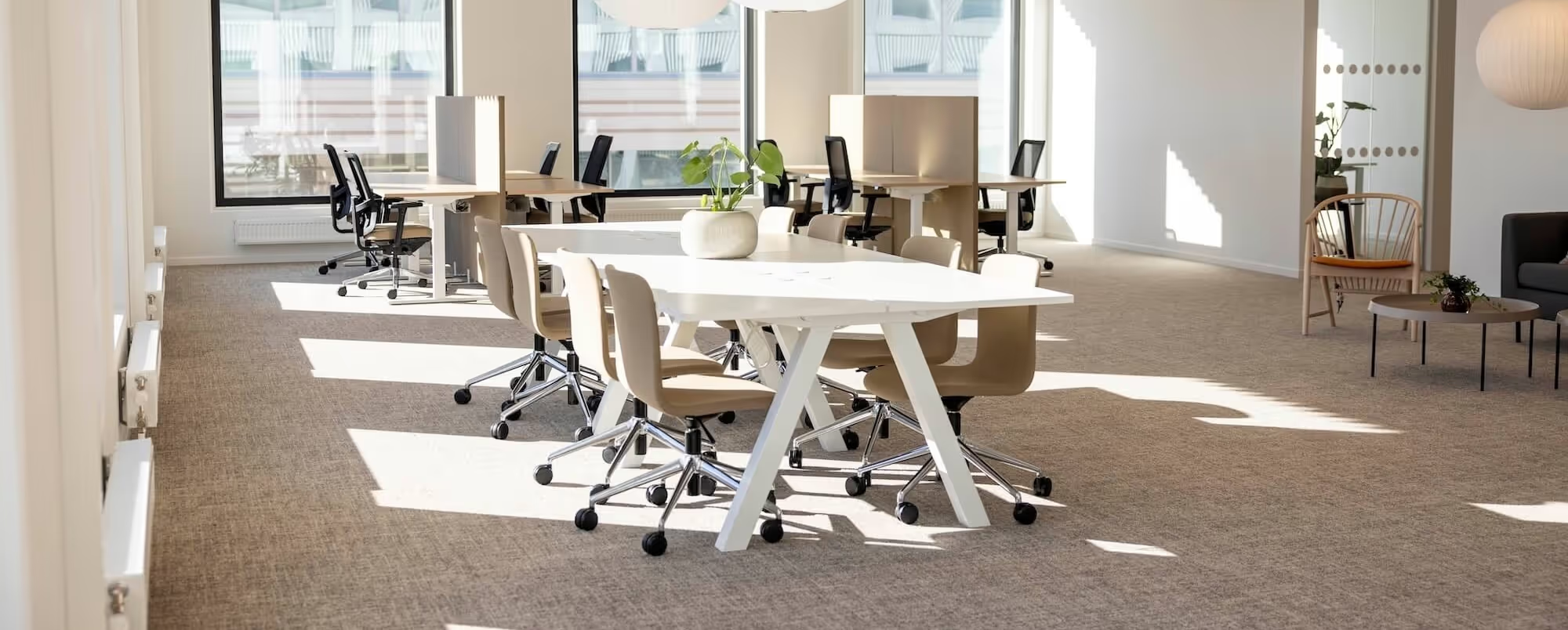
How Furniture as a Service works in practice
The process varies slightly by provider, but the core steps are consistent across most FaaS models.
- Submit your floor plan and requirements. You share the dimensions of your space, your team size, the zones you need, and any design preferences. The provider uses this to generate a workspace design.
- Receive a design proposal. Most providers will produce a 2D or 3D design of your furnished space within 24 to 48 hours. This lets you visualise the outcome before committing.
- Agree a monthly fee. FaaS is typically priced per square metre per month, covering furniture, design, delivery, installation, and ongoing flexibility.
- Furniture is delivered and installed. The provider handles all logistics. Because circular furniture is already in stock, installation timelines are typically weeks rather than months.
- Adapt as your needs change. If your team grows or your layout shifts, you request the change and the provider handles it.
- End of contract - no disposal problem. When your subscription ends, the provider collects the furniture. It is assessed, refurbished, and deployed to another client.
FaaS vs renting vs buying: what is the difference?
FaaS is often confused with furniture rental, but the two models are distinct in important ways.
- Rental is a logistics transaction with limited choice, higher monthly rates over time, and unpredictable environmental outcomes for returned furniture.
- Buying gives you ownership but comes with upfront capital expenditure, ongoing depreciation, and a disposal problem at the end.
- FaaS is a service, not a transaction. The provider retains ownership throughout. The furniture is designed for your space, installed professionally, and kept in circular use.
Who is Furniture as a Service designed for?
FaaS suits a wide range of businesses, but is particularly well matched to specific situations.
- Fast-growing companies that need to add workstations quickly and return them without a disposal problem if growth plateaus.
- Businesses moving offices - an office move is the natural moment to reassess your furniture model.
- Companies with ESG commitments that need measurable, documented impact data for scope 3 and zero waste reporting.
- Founders and CFOs managing capital who want to convert a large upfront cost into a predictable operating expense.
- Landlords and flex operators who need to furnish spaces without committing capital to furniture assets.
How FaaS supports a circular economy
The circularity of the FaaS model is what distinguishes it most clearly from buying or renting. Rather than producing furniture for a single use cycle, the model keeps each piece in continuous use across multiple clients and locations.
- Refurbishment extends lifespan. When furniture is returned, it is assessed, cleaned, reupholstered, and repaired before being deployed again.
- Nothing goes to landfill. The provider retains end-of-life responsibility. Furniture that cannot be refurbished is broken down and recycled.
- Measurable CO2 reduction. Circular models have been shown to reduce furniture-related CO2 emissions by up to 70% compared to buying new.
- Scope 3 data included. Reputable FaaS providers supply documentation on CO2 saved and materials diverted from landfill.
Key Takeaways
- Furniture as a Service is a circular subscription model - not a rental arrangement - where the provider retains ownership and end-of-life responsibility.
- FaaS converts upfront capital expenditure into a predictable monthly operating cost, freeing capital and simplifying balance sheet treatment.
- The model is designed for businesses that expect change - growing teams, office moves, hybrid transitions, or evolving layouts.
- Circularity is central to FaaS: furniture is refurbished and redeployed rather than disposed of, delivering measurable sustainability outcomes.
- NORNORM is one of Europe's leading FaaS providers, active in 17 countries and 59 cities.
If you want to understand what a FaaS model would look like for your space, get in touch with NORNORM for a no-obligation design and quote.