Office Furniture: Buying vs. Subscribing & The hidden costs
Buying office furniture often looks cheaper on paper, but for commercial real estate the real costs sit beneath the surface. This article breaks down the hidden financial, operational, and ESG impacts of ownership, and explains why subscription models are better aligned with how offices are leased, operated, and adapted today.
%20(1).avif)
Office Furniture: Buying vs. Subscribing & The hidden costs
A total cost view for landlords, operators, and asset managers
In the office market, furniture is often treated as a one-off fit-out decision. Buy once, depreciate, move on.
But when you step back and look at furniture through a portfolio and lifecycle lens, ownership becomes one of the least efficient parts of the office value chain. Not because furniture is expensive, but because it is static in a market that no longer is.
The Commercial Real Estate blind spot: furniture is priced as CapEx, but behaves like OpEx
In traditional procurement, furniture sits neatly in CapEx models:
- upfront fit-out budgets
- depreciation over five to ten years
- assumed residual value
On paper, it looks controlled.
In practice, furniture behaves like an operational cost. It moves, it ages, it becomes surplus, and it rarely aligns with the next tenant’s needs. Those costs do not disappear. They simply sit outside the initial appraisal.
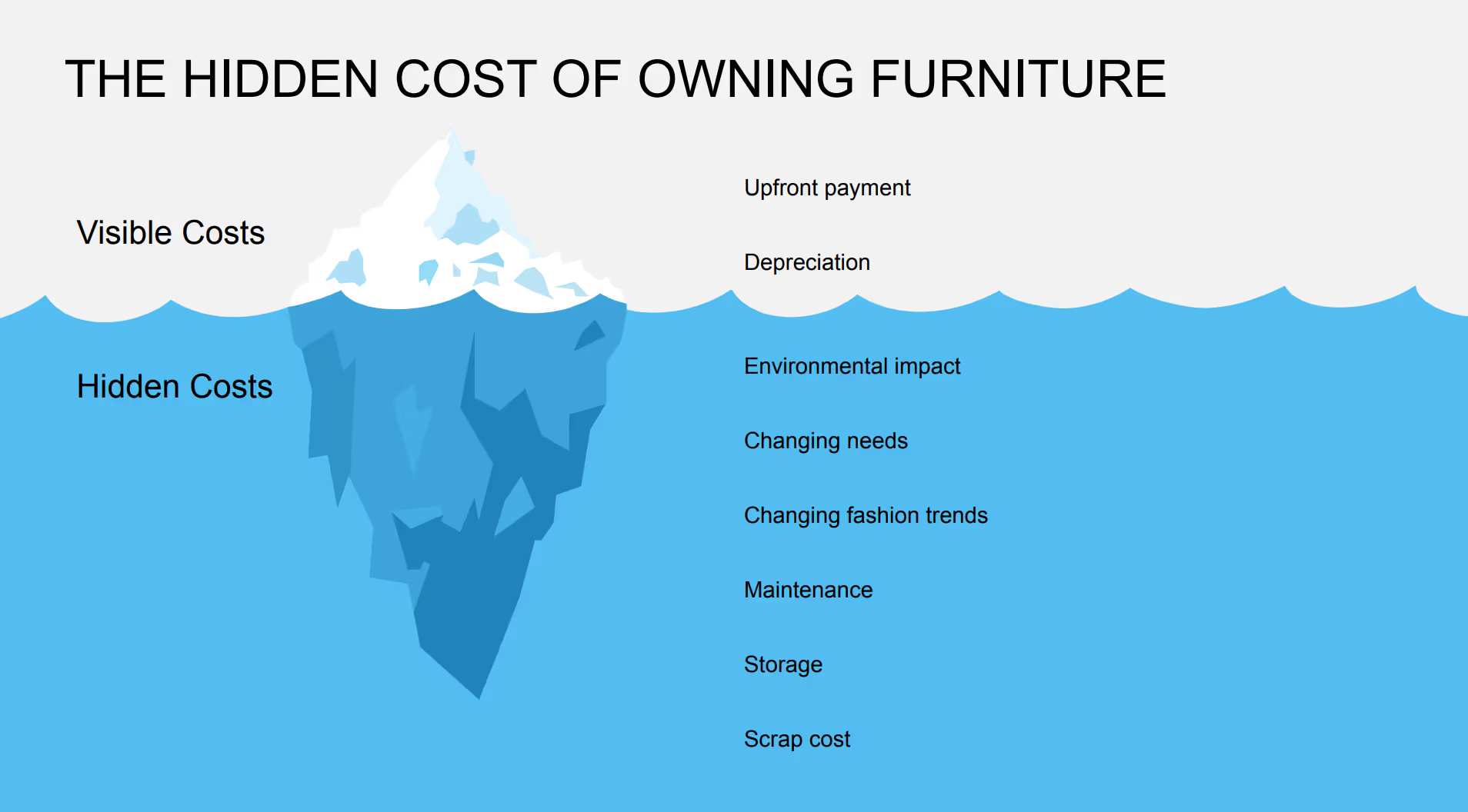
The hidden costs landlords and operators absorb
Across offices and flexible workspace portfolios, the same cost categories appear again and again:
- capital tied up at fit-out stage
- accelerated depreciation when layouts change
- logistics during churn, restacking, or refurbishments
- storage of surplus furniture between tenants
- maintenance and replacement of worn items
- disposal and scrap costs at lease end
- environmental impact affecting ESG reporting and asset quality
These costs are rarely attributed back to furniture decisions, yet they directly affect net operating income and leasing velocity.
Capital efficiency matters more in today’s office market
In a tightening market, capital efficiency has become a competitive advantage.
Every pound spent upfront on furniture is capital that:
- cannot be deployed into leasing incentives
- cannot improve base build or shared amenities
- cannot be used to respond to occupier demand
With the cost of capital sitting at meaningful levels across Europe, tying funds into depreciating furniture assets becomes increasingly difficult to justify, particularly for landlords and operators managing multiple assets.
Furniture subscriptions shift furnishing from CapEx to OpEx, aligning costs with income and occupancy rather than speculation.
Offices change more than leases suggest
From the outside, office buildings may look stable. Inside, they are constantly adjusting.
Across managed offices, flex spaces, and landlord-fitted floors:
- occupiers request changes roughly once per year
- around 10% of space is reconfigured annually
- most changes are functional, not cosmetic
Headcount shifts. Team structures evolve. Space is repurposed to support collaboration, focus, or new services.
Owned furniture turns each of these moments into friction: new purchasing, transport, storage, and write-offs. The cost is not just financial. It slows response time and increases vacancy risk.
Why subscription fits how the office market now operates
The modern office is no longer designed once per lease cycle. It evolves continuously to remain relevant.
A circular furniture subscription supports this reality by:
- keeping furniture in use across tenants and layouts
- reducing downtime between occupiers
- removing surplus and disposal decisions
- maintaining consistent design quality over time
For landlords and operators, this means faster transitions, lower friction, and clearer cost control. For occupiers, it means space that can adapt without renegotiation or reinvestment.
This is not a design shift. It is an operating shift.
Traditional furniture procurement assumes certainty: fixed layouts, long leases, predictable use.
The office market now operates on flexibility, optionality, and speed.
Subscribing does not eliminate cost. It makes cost visible, manageable, and aligned with how buildings actually perform over time. Furniture becomes infrastructure, not inventory.
And in a market where adaptability increasingly defines value, that difference matters.
How NORNORM turns furniture from a cost into an operating advantage
NORNORM was built for the realities of today’s office market. Our circular furniture subscription replaces upfront CapEx with a predictable operating model, allowing landlords and operators to furnish, adapt, and evolve spaces without carrying the long-term burden of ownership. Furniture moves between tenants, layouts change without waste, and quality remains consistent through timeless Nordic design. Instead of managing surplus, storage, and write-offs, assets stay flexible, relettable, and relevant. In a market defined by change, NORNORM makes adaptability the default, not the exception.
Sources:
- Turnerandtownsend.com. (2025). Home - Global office fit-out cost guide 2025.
- KPMG (2024). The New Dilemma: Balancing Interest Rates and Growth.
- Cbre.com. (2022). Global Office Fit-Out Cost Guide 2022-2023.
- Xie, W. (2025). JLL - Global State of Facilities Management Report 2025. Future-proof facilities management as a core engine for competitive advantage.
- BCO - British Council for Offices. (2024). Guide to specification - BCO - British Council for Offices.